
Part 1 was about what suppliers sell you (and why names are slippery) – Types of urushi. This Part 2 is about what you make on your bench: how craftsmen change urushi (漆 / うるし) by adding other materials — and how to choose the right mixture for the job.
Two hard rules before we get practical:
- Rule #1: Every mixture is a new lacquer. It won’t cure the same way as the “base” urushi you started from. Thickness, humidity, temperature, and airflow matter even more. Keep the curing basics in your head and use this as your reference: Curing Urushi — concept, tips, Q&A.
- Rule #2: Test panels beat beliefs. New supplier, new batch, new additive, new season = do a small test first. Label it with: mixture name, ratio, date, RH%, °C, and where it cured (shimeshiburo [湿し風呂] / karaburo [乾風呂] / ambient).
Safety note (non-negotiable): wet urushi can cause severe allergic dermatitis. Work like you’re not immune: nitrile gloves, sleeves, no face-touching, good ventilation for solvents, and a disciplined cleanup routine.
Table of contents
- 1) Mental model: why additives behave “weird” in urushi
- 2) Additive taxonomy (what you add, what it changes)
- 3) Mixture atlas (recipes you can actually use)
- 4) Choose by purpose (fast lookup)
- 5) Troubleshooting (by symptom + likely cause)
- 6) Sources & further reading
1) Mental model: why additives behave “weird” in urushi
Fresh lacquer sap isn’t a simple varnish. It’s a complex system: urushiol (漆酚 / urushiol) + water + plant gums/proteins + enzymes (mainly laccase) — basically a structured liquid that cures by enzyme-driven oxidation and polymerization under the right humidity and temperature.
So when you add “just a little” of something — water, flour, oil, powder, solvent — you’re not only changing thickness. You may be changing:
- how water is held in the film (clouding / blush risk, cure speed shifts)
- how oxygen and moisture reach the interior (skin-first curing, trapping uncured core)
- how the film shrinks (wrinkles, sink marks, cracks)
- adhesion vs brittleness (especially with powders/fibers)
That’s why “same name” does not guarantee “same behavior.” Two craftsmen can both say “sabi-urushi” (錆漆) and produce two materials with very different cure and sanding behavior — because their tonoko (砥の粉), their water-kneading (水練り / mizuneri), their urushi, and their ratios differ.
2) Additive taxonomy — what you add, what it changes
This section is organized by what you add (the useful way to think). The “Mixture atlas” below is organized by what you end up making (the way you’ll search mid-project).
2A) Water (水 / mizu) & water-kneading (水練り / mizuneri)
What it does: changes viscosity and dispersion, helps wet powders (tonoko/jinoko) evenly before urushi is introduced, and can make pastes easier to knead and smoother to apply.
Typical appearances: water is usually not “added into urushi” like a solvent — instead it’s used to pre-knead the powder (mizuneri) so you don’t trap dry clumps that later become weak points.
Risks: too much water can push you into slow/uneven curing, surface clouding, or a paste that slumps and shrinks. Thick layers + high humidity can skin over and stay soft inside. If you see that pattern, go back to the cure logic in the curing article.
2B) Oils (油 / abura): drying oils in urushi
What it does: oil additions (often perilla oil [荏油 / egoma-abura] in traditional contexts; sometimes other drying oils) can increase leveling and gloss and often slow the initial set. This is why many “nuritate” (塗立て) topcoats are oil-modified (e.g., shuai-urushi [朱合漆]).
Risks: more open time = more dust risk, more chance of sags, and more “fingerprint memory” if you touch too early. Oil-modified lacquer is also easier to over-apply; thin wins.
2C) Starches: rice paste (米糊 / kome-nori) & wheat paste (小麦粉糊)
What it does: starch pastes give you adhesive body and “grab” — crucial for bonding, cloth reinforcement, and some undercoat systems. In urushi language, this world includes nori-urushi (糊漆) and the glue component used in honkataji-type groundwork.
Risks: these are water-based. Too much paste can soften strength, extend cure times, and increase shrinkage. Also: shelf life is short. Make small batches.
2D) Proteins (タンパク質 / tanpakushitsu): where they show up (and where myths live)
Where proteins appear in practice:
- Wheat flour in mugi-urushi (麦漆) brings starch and protein — it’s not just “thickener,” it’s a different adhesive system.
- Protein-added urushi exists as a commercial product (often described as “kaburenikui urushi” [かぶれにくい漆]). These products typically increase viscosity and can change cure behavior.
- Traditional/experimental “shibo-urushi” (絞漆) variants may involve proteins (e.g., tofu/egg white) to change texture and rheology — but this is a high-risk zone: separation, instability, UV aging differences, and inconsistent results unless you truly know what you’re doing.
Hard stance: do not rely on “protein reduces allergy” folk claims unless you’re using a documented commercial product and you still treat it as allergenic. Allergy is medical territory; craftsmanship is not a substitute for immunology.
2E) Mineral powders (粉 / kona): tonoko, jinoko, charcoal, and friends
Tonoko (砥の粉): fine mineral powder used to make smooth pastes (sabi-urushi) for filling small voids, leveling, shaping, and creating sandable surfaces.
Jinoko (地の粉 / ぢのこ): coarser powder (often described as diatomaceous earth–like in some regions) used in stronger undercoat systems (“ji” work). Typically rougher, stronger, and more structural than tonoko pastes — but also more likely to show texture if you don’t cover and refine it properly.
Charcoal powders: used in some undercoat traditions (e.g., “somi-urushi” [惣身漆] style mixtures) and for adjusting sanding behavior and bite.
Risks: all powders increase shrink and can crack if you apply too thick in one go. Thickness limits and multi-pass filling matter.
2F) Fibers (繊維 / sen’i) & reinforcement
Fibers as additives: cotton, hemp, paper fibers, wood fibers — they increase body and “bridging” strength. They are a key part of kokuso (刻苧) type putties.
Nunokise (布着せ): not an additive — a technique. Cloth reinforcement is a method that uses an adhesive mixture (typically nori-urushi [糊漆] or related) to bond cloth onto the base, then builds over it. Treat it as: technique + adhesive choice.
2G) Solvents & diluents (溶剤 / yozai): turpentine, kerosene, etc.
What they do: reduce viscosity, improve wiping behavior, change leveling and penetration, and enable special effects. Common examples in craft contexts include turpentine (テレピン油 / terebin-abura) and other traditional diluents.
Important distinction: solvents thin by temporarily diluting (then evaporate). Water changes the internal emulsion behavior and interacts with powders/pastes differently.
Risks: too much solvent can cause crawling, weak films, trapped solvent, or weird surface tension defects. Also: ventilation and fire safety become real.
2H) Resins (樹脂 / jushi): rosin, copal, and “urushi-like” coatings
There are lacquer products on the market that include added resins (e.g., rosin [ロジン / rojin], copal [コーパル / koparu]) and other ingredients. Sometimes this is done for cost, sometimes for working properties, sometimes because the product is not “pure urushi” but a labeled coating category.
Practical buying advice (Workshop practice):
- If the label is vague (“special transparent lacquer”), ask the supplier what’s inside (oils? resins? solvent?).
- If the supplier can’t or won’t answer, assume it’s a different material class and test it like one.
- Don’t mix unknown resin-lacquers into your known urushi system unless you’re doing controlled tests — they can behave fine alone but become unpredictable in blends.

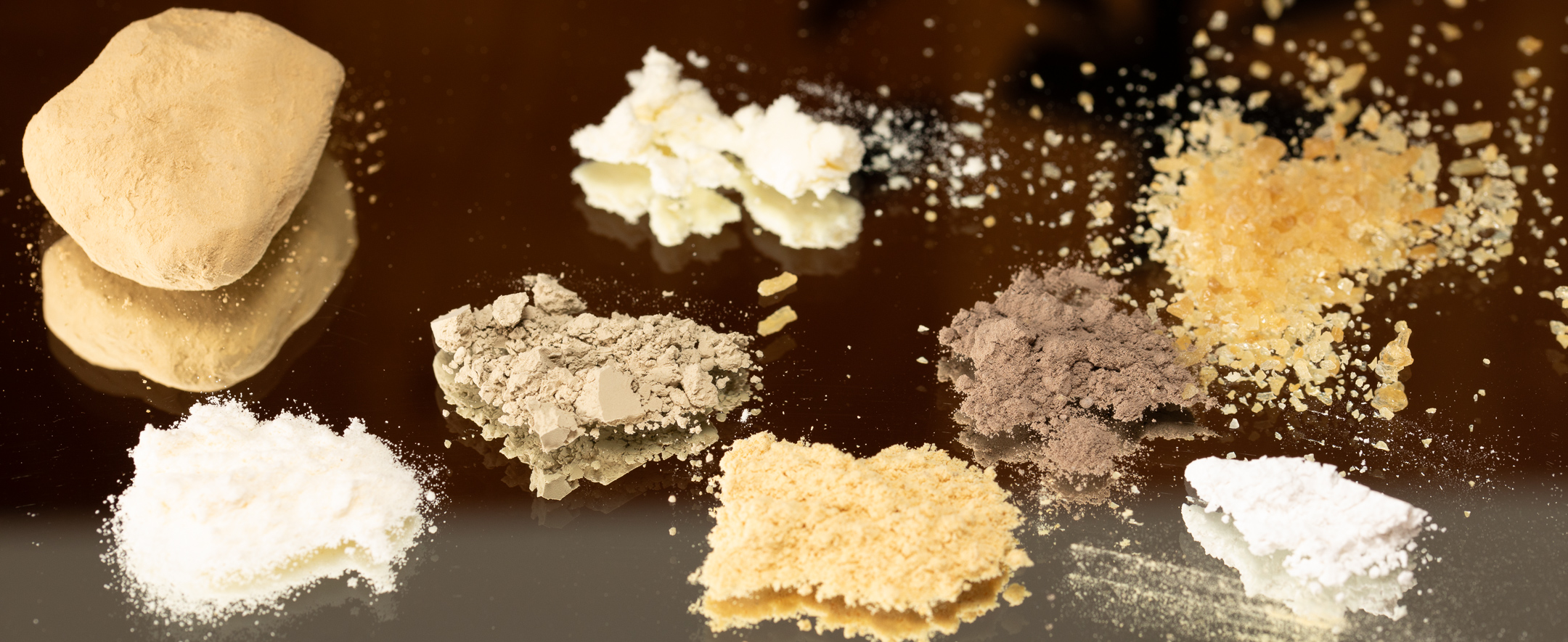
From the left: tonoko, rice flour, whetstone powder, albumin (egg white), wood powder, jingo, nikawa, wheat flour
3) Mixture atlas — the stuff you actually make
Format: what it is, how to mix, pot life, cure notes, and how it fails.
Nori-urushi (糊漆) — rice-paste lacquer adhesive
What it is: a mixture of rice paste (kome-nori [米糊]) and raw urushi (ki-urushi [生漆 / 木漆]). Used as an adhesive/binder and as the glue in cloth reinforcement systems.
Best for: nunokise (布着せ) cloth reinforcement, bonding porous substrates, binding powders in certain groundwork traditions, “grabby” undercoats where you want mechanical bite.
Not for: high-precision cosmetic top layers; anything where you demand maximal transparency; thick one-shot fills (use kokuso instead).
Starter ratio (Workshop practice): start at rice paste : raw urushi ≈ 6 : 4 (by volume) for cloth/adhesive work. For stronger, less “starchy” behavior go leaner on paste (e.g., 3:7). Adjust by feel: you want a smooth, creamy adhesive that spreads thin without stringing.
Target consistency: mayonnaise / thick cream. Thin enough to wet cloth and wood, thick enough not to run.
Working time / pot life: short. Make what you need. Same day is best; 1–2 days is typical before performance drops (it tends to cure worse as it sits).
Cure notes: thin films cure easiest. Use shimeshiburo (湿し風呂) around 60–75% RH, 20–25°C. For thick glue blobs, don’t rush: let it set fully before overcoating. When in doubt, use the curing logic here: curing article.
Common failures & fixes:
- Soft for days: too much paste or too thick. Scrape back and remake leaner; cure thinner; avoid high humidity “skin-over” on thick blobs.
- Weak bond: contaminated surfaces (oil, dust), or too dry cure early. Clean, re-prep, use proper RH band.
Mugi-urushi (麦漆) — wheat-flour urushi adhesive
What it is: raw urushi (ki-urushi [生漆]) mixed with water-kneaded wheat flour (小麦粉). Used in kintsugi (金継ぎ) as a default adhesive.
Best for: bonding cracks and joins, especially where you want a tougher adhesive than rice-paste mixes; adhesive base for kokuso.
Starter ratio (Tradition → Workshop practice):
- Simple volume rule: flour : raw urushi ≈ 1 : 1 to 3 : 5 (by volume) after the flour is kneaded with water into a smooth dough-like paste.
- Weight starting point (more repeatable): flour 4 : water 4 : urushi 5 (by weight) — then adjust slightly by feel.
- Note: too much flour makes the joint brittle over decades (yes, we think in this timescale); when in doubt, lean toward more urushi.
Target consistency: thick sticky putty that strings slightly but still wets the surfaces when pressed.
Working time / pot life: limited. In many workshop contexts it’s treated as 3–4 days max in cool storage, but best performance is early. Make small batches.
Cure notes: shimeshiburo (湿し風呂), 70–80% RH, 20–25°C is typical. Thick adhesive lines need time; don’t overcoat too soon. Use the curing article when you hit “cured outside, soft inside” patterns.
Common failures & fixes:
- Joint creeps/moves: too wet (too much water) or too thick/slow cure. Make a firmer flour paste, clamp properly, allow longer cure.
- Weak bond: poor surface prep or too little urushi binder. Increase urushi fraction slightly, and improve surface prep.
Sabi-urushi (錆漆) — tonoko paste for filling & leveling
What it is: tonoko (砥の粉) + water (mizuneri [水練り]) + raw urushi (ki-urushi [生漆]). This is your “mud paste” for fine filling and shaping.
Best for: pinholes, small chips, shallow gaps, leveling transitions, shaping crisp edges, creating sandable planes before middle/top coats.
Thickness discipline: treat it like body filler: build in passes. If you try to fill deep voids in one go, it will shrink, crack, or cure unevenly.
Starter ratio (Tradition → Workshop practice): tonoko : raw urushi ≈ 10 : 7–8 (by volume). Water is added first just to knead tonoko into a cohesive paste — not to make soup.
Target consistency: thick mud / clay slip — spreads, holds shape, doesn’t slump immediately. If it strings like lacquer, you’re too rich in urushi.
Working time / pot life: short. Often treated as 1–2 days usable at best; fresh is best. Old sabi tends to cure worse.
Cure notes: shimeshiburo (湿し風呂), 70–80% RH, 20–25°C. Thick fills need longer — don’t rush sanding if the interior is still soft. Use: curing article.
Common failures & fixes:
- Wrinkling / “shrink skin”: too much urushi binder or too thick at once. Scrape and redo leaner/thinner in passes.
- Crumbly/weak: too little urushi binder or poor kneading. Add slightly more urushi, knead longer, and ensure tonoko is well broken down.
Jinoko mixes (地の粉 / ぢのこ) — structural undercoat pastes
What it is: jinoko (地の粉) is used to build stronger, more structural groundwork layers than tonoko. Different regions have different “house recipes,” but the core idea is consistent: a mineral-filled undercoat with urushi binder (often with a paste component).
Two common practical families:
- Awase-urushi + jinoko: awase-urushi (合わせ漆) typically means urushi combined with a paste/binder system; then jinoko is mixed in (often with water adjustment). This is common in honkataji-type foundation work.
- Region-specific “jinoko sabi” recipes: e.g., examples documented for Wajima groundwork use combinations like awase-urushi + jinoko with water adjustment, and sometimes multiple grades of jinoko depending on layer stage.
Starter ratio example (documented practice): one documented undercoat blend uses awase-urushi ~70% + jinoko ~30% (then adjust with water to workable paste). Treat this as a starting point, not a universal law.
Target consistency: thicker than sabi-urushi; you want a paste that can be spread and leveled but doesn’t flow. Jinoko particles give body quickly.
Working time / pot life: short; make small batches. Undercoat pastes also “dry out” faster on the palette.
Cure notes: these are often thicker, so avoid extreme humidity that causes fast skinning. Start in the 60–75% RH band at 20–25°C in shimeshiburo (湿し風呂) and adjust based on your observed behavior (see curing article).
Somi-urushi (惣身漆) — charcoal powder + urushi + paste (undercoat binder)
What it is: a traditional-type undercoat mixture using charcoal powder (often described as somi-ko [惣身粉]) combined with urushi and paste (sabi-urushi etc). In documented Wajima-style explanations it appears as a key undercoat/binder material in groundwork systems.
Why it exists: charcoal powder changes sanding bite and mechanical behavior, helps build a strong intermediate foundation, and can improve the “tooth” for later coats.
Practical note: this is not a beginner’s first mixture unless you are specifically studying that groundwork tradition. If you just need filling/leveling, sabi-urushi and kokuso are more direct tools.
Kokuso (刻苧) / Kokusō-urushi (刻苧漆) — urushi putty for rebuilding
What it is: a putty made by mixing mugi-urushi (麦漆) with wood powder (木粉 / mokufun). Other fibers are also used in broader “kokusō family” practices, but the core beginner-safe definition is: mugi-urushi + wood powder.
Best for: deep chips, missing corners, rebuilding lost volume, forming a new edge, filling gaps deeper than ~2 mm (build in layers if deeper).
Starter ratios (two practical ways):
- Quick volume rule: flour : raw urushi ≈ 10 : 10 (volume) to make the mugi base, then add wood powder until your spatula barely stops sticking (that’s a good “putty threshold”).
- More repeatable weight rule: flour 4 : water 4 : urushi 5 (weight) to make mugi, then mugi 10 : wood powder 4–6 (weight) for kokuso.
Target consistency: clay/putty. It should hold a shape and be sculptable. If it’s crumbly, add a little more mugi. If it’s sticky slime, add more wood powder.
Working time / pot life: limited (same constraints as mugi). Make what you need. Don’t make a week’s supply “because it’s convenient.” It stops being convenient when it stops curing well.
Cure notes: thick putties are the classic “skins over, stays soft inside” trap. Use shimeshiburo (湿し風呂) but don’t push humidity to extremes. Typical starting band: 70–80% RH, 20–25°C, and give it real time before sanding/overcoating. Use the curing logic: curing article.
Nunokise (布着せ) — cloth reinforcement (technique + adhesive choice)
What it is: cloth reinforcement where you bond fabric to a base, then build over it. The “mixture” decision is mainly: which adhesive urushi system you use.
Typical adhesive: nori-urushi (糊漆). Some lineages use related paste-lacquer adhesives depending on the groundwork system.
Key success factor: thin, even adhesive film that fully wets the cloth and substrate; no trapped air; good pressure; then cure fully before building thickness above it.
Seirei-nuri (蜻蛉塗り) — solvent-driven surface pattern (special effect)
What it is: a kawari-nuri (変わり塗り) effect where thinned urushi is used to create floating/halo-like patterns (often using a water surface as the “pattern generator” – urushi spread on surface and object dipped in it), then transferred to the object.
What matters here: this is not “foundation chemistry.” It’s surface tension, evaporation, viscosity, and timing. You usually thin urushi with a lacquer solvent (溶剤 / yozai) such as turpentine-type thinners (テレピン油). The solvent choice and ratio change the entire behavior. Often more than solvent is used – turpentine to thin urushi and alkohol to decrease surface tension in contact with water.
Why it’s here (and only here): because solvent is one of the big “other additives” people forget. And this is a clean example where solvent is the point, not an accident.
Cure notes: once transferred, it becomes a normal urushi film again — but thin films are sensitive to dust and to overly wet curing that can cloud the surface. Use your curing reference and test panels.
4) Choose by purpose (fast lookup)
| I need to… | Use… | Watch out for… |
| bond a crack / join two parts | mugi-urushi (麦漆) | too wet mix, poor clamping, rushing cure |
| reinforce a weak area with cloth | nunokise (布着せ) + nori-urushi (糊漆) | air bubbles, thick glue blobs, under-cured adhesive |
| fill pinholes / tiny chips / shallow gaps | sabi-urushi (錆漆) | too thick at once, too rich in urushi (wrinkles) |
| rebuild missing corner / deep chip / sculpt volume | kokuso (刻苧) | skin-over / soft core, shrink, cracking if too thick |
| build structural undercoat (traditional groundwork study) | jinoko mixes (地の粉) / somi-urushi (惣身漆) | recipe drift, rough texture, curing too wet/too thick |
| create solvent-driven surface patterns | seirei-nuri (蜻蛉塗り) | solvent safety + unpredictability without tests |
5) Troubleshooting — fast diagnosis
This is intentionally blunt. These are the patterns you’ll actually see.
Symptom: surface is hard but inside is still soft
- Most likely: layer too thick + too humid cure caused skin-first curing.
- Fix: remove uncured core if necessary; reapply in thinner passes; use a less aggressive humidity band; extend cure time. Use the curing article’s logic, not guesswork.
Symptom: paste wrinkles / “shrivels” / forms a shrunk skin
- Most likely: too much urushi binder in sabi, or too thick application.
- Fix: scrape, remake with higher powder fraction, apply thinner in layers.
Symptom: paste is crumbly / weak / powders out when sanded
- Most likely: not enough binder, poor kneading, or powder agglomerates.
- Fix: knead longer, add slightly more urushi, and use proper mizuneri for powders.
Symptom: adhesion fails (joint pops, cloth peels)
- Most likely: contamination (oil, dust), insufficient wetting, or curing too dry early.
- Fix: re-prep surfaces, apply thinner adhesive layer, ensure correct RH band for the first cure stage.
Symptom: crawling / fisheyes / “won’t wet the surface”
- Most likely: oil contamination or excessive solvent thinning changing surface tension.
- Fix: degrease properly, reduce solvent, and test on scrap before committing.
6) Sources & further reading
For curing logic and RH/°C bands, use this as the master reference and keep your process consistent with it:
Terminology reminder: urushi terms drift across regions. To keep it in reasonable consistency read this article and use glossary as reference.
- Types of urushi
- Urushi glossary
- This “map” of urushi styles in Japan can be helpful too.
Note: If you spot a mixture name used differently by your supplier, trust the behavior you observe on tests over the label. Names are hints, not laws of physics.


